Most Durham homeowners pick one and regret it. A doorbell camera is great at catching the person on your porch. A driveway camera is great at catching the vehicle that brought them there. Neither one does the other's job well. The good news: you don't need two separate subscriptions to run both. A wired system handles both cameras on the same recorder, the same app, and the same hard drive, with no monthly fee.
Key Takeaways
- Doorbell cameras cover porch-level activity. Driveway cameras cover the approach zone and license plates.
- The coverage gap between them is where most residential incidents happen.
- Over 5 years, a wired driveway camera costs less than a single doorbell subscription.
- Most Durham homes benefit from running both on one wired NVR system.
- See our camera placement guide for a full 4-camera layout.
What do doorbell cameras do well (and where do they fall short)?
Doorbell cameras excel at one specific zone: the six to eight feet directly in front of your front door. That's their strength. According to the Insurance Bureau of Canada, package theft and porch-level property crime rank among the most common residential claims in Ontario. A doorbell camera documents exactly that, and its two-way audio lets you speak to anyone at your door remotely.
The weak spots are real, though. Most doorbell cameras use a wide fisheye lens designed for close-range faces, not long-range footage. That same lens that captures a perfect face at three feet produces a blurry, distorted image at twenty feet. Approaching vehicles, street-level activity, and the full length of your driveway sit well outside the zone where a doorbell camera gives you usable footage.
Night vision is another limitation worth knowing. Consumer Reports testing of popular doorbell cameras found that most produce usable colour video only within eight to ten feet in low light. Beyond that range, the image degrades fast. If your driveway is more than one car length, the vehicle at the end of it is essentially invisible at night on a doorbell camera alone.
When we sit down with homeowners after incidents where a doorbell camera captured a clear face, but the vehicle used to case the property came from the street and never appeared on camera at all, that gap matters when Durham Regional Police are trying to identify a suspect.
The subscription question
Every major consumer doorbell camera, including Ring and Nest, requires a paid plan to access stored footage. Ring's Basic plan runs $5.99 CAD per month, or $59.99 per year, for a single camera. Nest Aware starts at $8 CAD per month. Those fees are ongoing, every year, forever.
Where does a driveway camera earn its keep?
A dedicated driveway camera, mounted at soffit height on the front corner of your home, covers the approach zone that a doorbell misses. It captures vehicles entering and leaving your property, license plates at street level, and anyone moving along the front of your house. Durham Regional Police annual crime statistics consistently show that residential property crime, including vehicle break-ins and driveway-based theft, is the most common property offence across Oshawa, Whitby, and Clarington.
A 4K wired camera at the soffit corner gives you a field of view that typically covers the entire driveway plus several metres of street in both directions. At 4K resolution, license plates are readable at distances where a doorbell camera produces nothing useful. That footage is what actually advances a police investigation. See why 4K resolution matters for plates.
The other advantage of a wired driveway camera is continuous recording. It records every vehicle that passes, not just the ones that trigger a motion alert. Consumer doorbell cameras typically rely on motion-activated clips, which means anything that happens between clips, a slow roll-past, someone on foot, a vehicle idling at the curb, isn't captured.
The coverage gap: what each camera misses when it's the only one
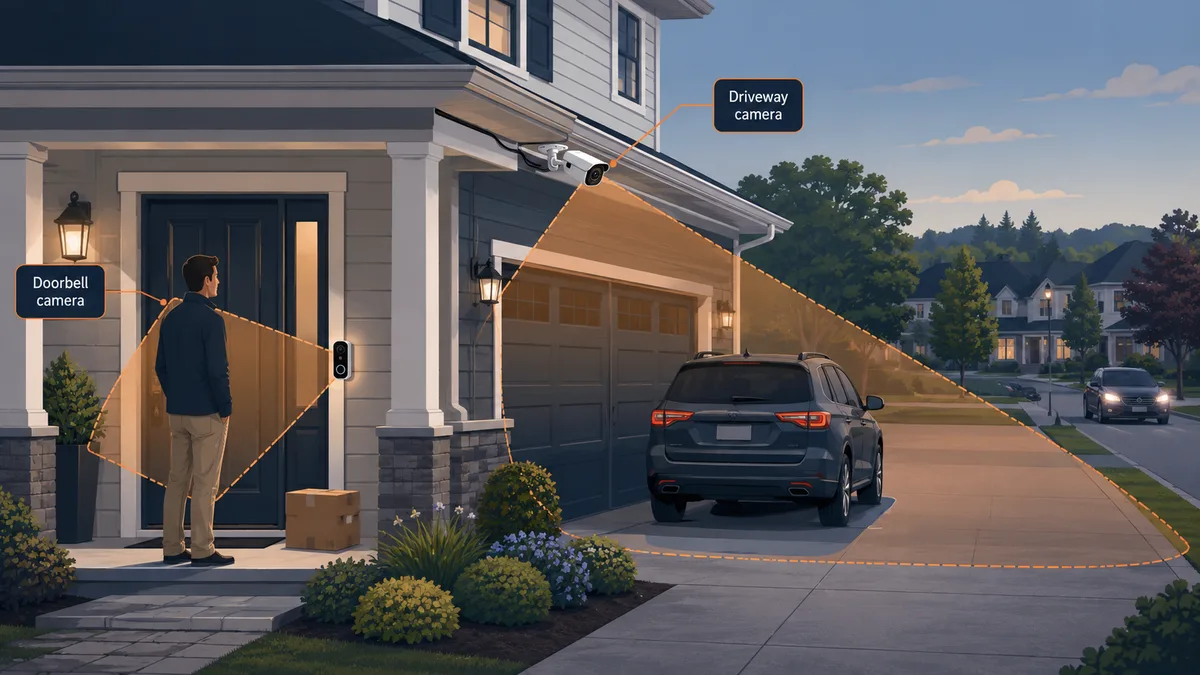
The gap between a doorbell camera's coverage zone and a driveway camera's coverage zone isn't a technical accident. It's a design choice. Doorbell cameras are optimized for the three-foot face-shot. Driveway cameras are optimized for the twenty-foot plate-read. Neither manufacturer expects their device to do both jobs.
On a typical Durham detached home, the doorbell sits at roughly six feet of height beside the front door. Its optimal coverage zone ends at about twelve to fifteen feet. A driveway on a standard Durham lot runs thirty to forty feet from the door to the street. That leaves fifteen to twenty-five feet of uncovered approach zone, which is precisely where most vehicle-based incidents begin.
This matters in practice. Property crime rarely starts at the front door. It starts at the street, with a vehicle slowing down, or a person walking the sidewalk and turning in. By the time someone is close enough for a doorbell camera to capture a useful image, they've already completed their approach in an unmonitored zone.
Public Safety Canada's crime-prevention guidance notes that visible camera coverage of the approach path, not just the door, is one of the strongest documented deterrents to residential property crime (Public Safety Canada, Crime Prevention Through Environmental Design, 2013). Deterrence requires coverage that starts before someone reaches the porch.
See our full camera placement guide.
Cost over 5 years: doorbell subscription vs. wired driveway camera
Running the numbers honestly makes the wired option look more attractive than it first appears. A consumer doorbell camera costs roughly $200 to $350 CAD for the device. Add a Ring Basic or Nest Aware subscription and you're paying $60 to $100 CAD per year, indefinitely, just to access recorded footage from one camera.
Over five years, that's $300 to $500 in subscription fees on top of the hardware cost. Total outlay: $500 to $850 for one camera, with footage stored in a third-party cloud you don't control, and service that stops the moment you stop paying.
A wired driveway camera added to a professional NVR system, by comparison, is typically $199 installed as an add-on to an existing package. See add-on pricing. Footage records locally to your hard drive. No monthly fee. No cloud dependency. If your internet goes out, the camera keeps recording. After five years, the cost is exactly what you paid at install, nothing more.
In our experience, homeowners who start with a consumer doorbell camera alone tend to come back within 12 to 18 months asking to add a wired system after a property incident that the doorbell missed. The smarter sequence is usually to plan the full layout at the assessment stage, add the doorbell as a supplementary camera on the same wired system, and skip the subscription entirely.
What the Insurance Bureau of Canada says about hardwired systems
The Insurance Bureau of Canada recommends hardwired camera systems over wireless cloud-dependent cameras specifically because continuous local recording provides the evidential continuity that insurers and police require. A 30-second motion clip from a subscription camera is not the same as continuous 4K footage with verified timestamps.
Some Ontario home insurers offer discounts of 5 to 15 percent on the homeowner's portion of your policy when you have a hardwired camera system with a local recorder. Ask your broker once the system is installed. We'll email you a spec sheet for them.
The "both" plan: coverage map for a typical Durham house
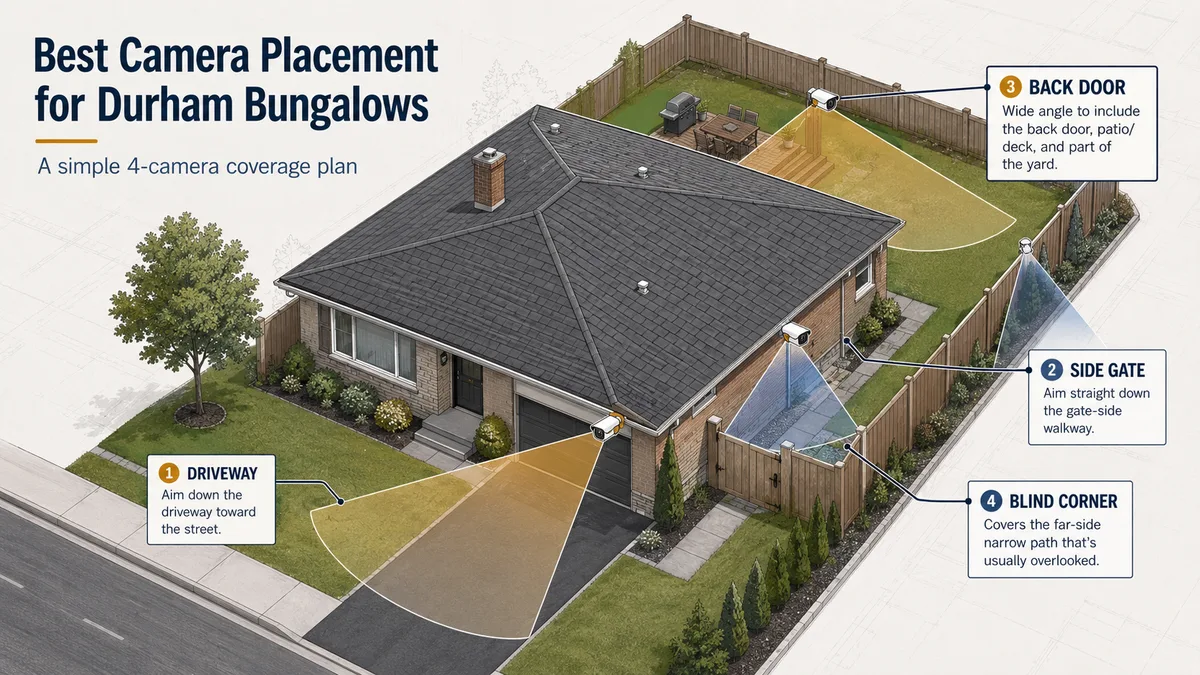
Running both a doorbell camera and a driveway camera doesn't mean buying two separate systems. It means planning one wired system that includes both. Here's how that layout works on a standard Durham detached home.
Doorbell camera (front door, porch level, six feet high): Covers faces, packages, and anyone at the door. Hardwired with a chime unit inside. Records to the same NVR as every other camera on the system. No separate subscription.
Driveway camera (front soffit corner, twelve to fourteen feet high): Covers the full driveway, the approach from the street, and vehicles parked in front of the house. At 4K resolution, reads plates at twenty to thirty feet. Records continuously.
Side gate camera (side soffit, same height): The most-overlooked coverage point on Durham homes. This is the camera that catches someone moving from the driveway to the backyard. See our side gate placement guide.
Back door camera (rear soffit corner): Wide enough to cover the patio and the back yard. If you have a detached garage or shed, angle it to include the outbuilding.
Four cameras cover the complete perimeter on a typical Durham bungalow or semi. The doorbell is an add-on, not a replacement. It does its specific job, the driveway camera does its specific job, and together they close the gap.
When do you actually only need one?
It's worth being straight about this: not every home needs four cameras and a full NVR install. There are situations where a single camera, positioned correctly, handles most of the risk.
You might only need a driveway camera if your front door sits back from the street, protected by a covered porch or covered entry, and your primary concern is vehicle security and approach monitoring. A 4K soffit camera angled down the driveway covers plates, vehicles, and anyone walking in, even if it doesn't close-up the face at the door.
You might only need a doorbell camera if you rent an apartment or condo where you have no control over exterior mounting, your lease doesn't allow hardwired installs, and your concern is limited to package delivery and door-level activity.
The case where a standalone doorbell camera is the right choice for a full Durham detached home is genuinely rare. If you own the property and have a driveway, the approach zone is almost always worth covering.
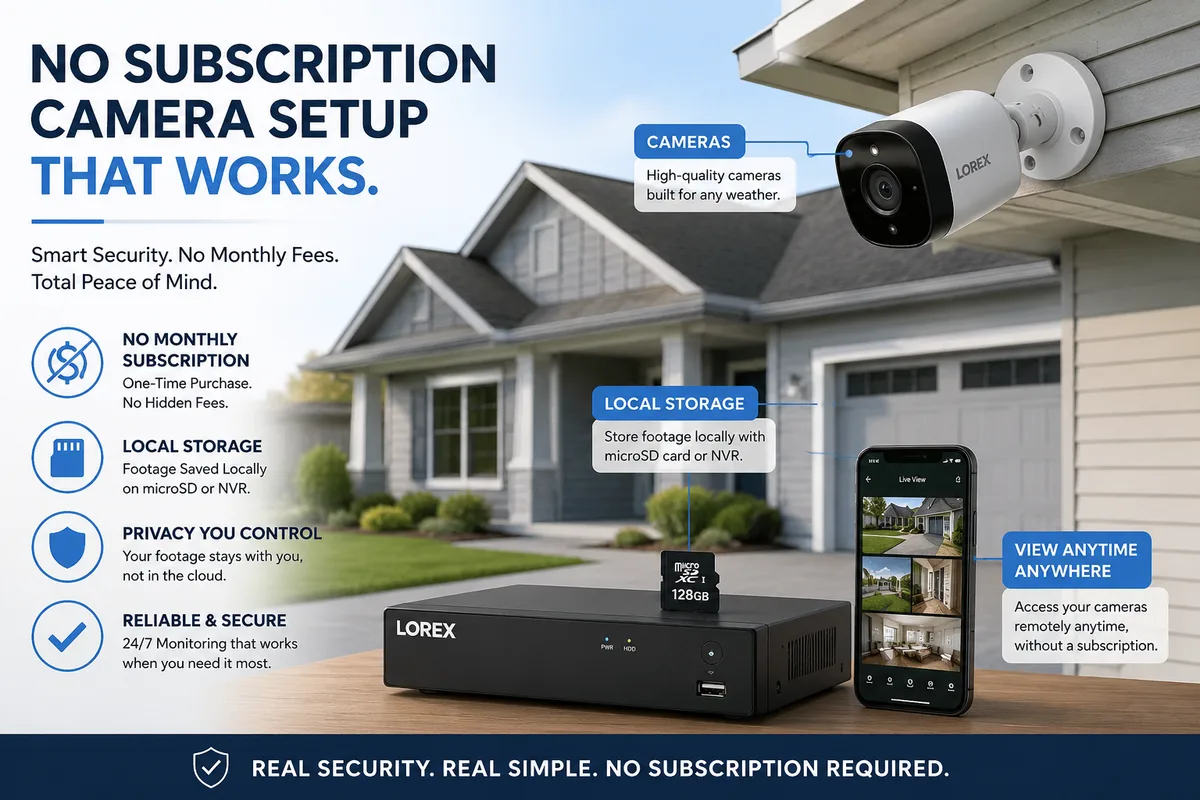
See our no-subscription wired system overview.
Frequently asked questions
Can I add a doorbell camera to a wired NVR system, or do I need a separate hub?
You can add a doorbell camera to a wired NVR system. Our doorbell add-on is a 2K hardwired unit that connects directly to the NVR via PoE, just like any other camera on the system. It appears in the same app, records to the same hard drive, and requires no separate subscription or hub. The chime unit runs inside the house from the same wiring. (Insurance Bureau of Canada, 2024)
Do Ring and Nest cameras record continuously, or only on motion?
Both Ring and Nest default to motion-activated recording on their standard paid plans. Ring's Basic plan stores motion-triggered clips for sixty days. Continuous 24/7 recording on Ring requires the Ring Protect Pro plan at a higher monthly cost. Nest Aware's entry plan also records motion clips. A wired NVR records continuously, around the clock, to a local hard drive. (Consumer Reports, 2024)
Will a doorbell camera catch a license plate?
Usually not, reliably. Most doorbell cameras use wide-angle fisheye lenses optimized for face-to-face range. At the distance where a vehicle sits in a driveway or at the street, the image is distorted and too low in resolution to read plates. A 4K bullet camera mounted at soffit height and angled down the driveway is the correct tool for plate capture. (Privacy Commissioner of Canada, PIPEDA guidance on residential cameras, 2023)
What's the privacy situation with a driveway camera that covers the street?
The Privacy Commissioner of Canada's residential guidance confirms that homeowners are permitted to record public areas like streets and sidewalks visible from their own property, provided cameras are clearly visible and not concealed. Recording a neighbour's private space, a window, or a yard over their fence, requires their consent or a privacy zone configured at the NVR. We configure privacy zones as part of every installation walkthrough.
Is a wired system harder to install than a Wi-Fi doorbell?
Yes, it takes longer. A professional wired install on a 4-camera system runs four to six hours. A consumer Wi-Fi doorbell takes about thirty minutes to hang yourself. The tradeoff is reliability, image quality, and total cost over time. Wi-Fi cameras are subject to signal interference, bandwidth limits, and subscription costs. Wired cameras are not. See what installation day looks like.
Most homes in Durham have a thirty-foot gap between their front door and the street. The doorbell camera watches one end of that gap. The driveway camera watches the other. Running both on one wired system closes the gap permanently, without a monthly bill.